

Aligning Teams During Periods of Rapid Change

Change rarely happens one department at a time.
A new strategy affects marketing.
A technology implementation affects operations.
A shift in customer expectations affects sales and customer success.
A new business model affects almost everyone.
Yet organizations often manage change through individual teams, initiatives, and communication plans.
That's where alignment starts to break down.
People may understand what is changing without understanding why it matters, how it affects their role, or what they should prioritize next.
During periods of rapid change, alignment isn't about getting everyone to agree on everything. It's about getting the organization moving in the same direction.
Why Rapid Change Creates Organizational Friction
Change creates uncertainty.
When priorities shift quickly, teams naturally begin filling gaps with their own assumptions.
One team may prioritize speed.
Another may prioritize risk reduction.
Another may focus on customer impact.
Leadership may be balancing all three.
None of these perspectives are necessarily wrong.
But without a shared direction, they can produce conflicting decisions.
The faster the organization changes, the more expensive misalignment becomes.
Alignment Is More Than Communication
Many organizations respond to change by communicating more.
More emails.
More meetings.
More presentations.
More announcements.
Communication matters, but information alone doesn't create alignment.
Teams need clarity around four things:
Direction — Where are we going?
Purpose — Why are we changing?
Priorities — What matters most right now?
Ownership — What is each team responsible for?
Without these four elements, communication can actually create more noise.

The Hidden Cost of Misalignment
When teams aren't aligned, the effects show up across the organization.
Duplicated Effort: Multiple teams solve the same problem independently.
Conflicting Priorities: Resources are allocated toward initiatives that compete with one another.
Slower Decisions: Teams wait for clarification before moving forward.
Inconsistent Customer Experiences: Different departments respond to customers based on different priorities.
Change Fatigue: Employees begin experiencing every new initiative as another disruption rather than part of a coherent direction.
The result isn't simply frustration. It is lost momentum.
What Organizational Alignment Actually Looks Like
Alignment doesn't mean every team works the same way.
It means teams understand how their work connects.
Marketing may have different objectives from Operations.
Sales may measure different outcomes from Customer Success.
But everyone should understand:
The organization's strategic direction
The outcomes that matter most
How their work contributes
Which priorities take precedence
Where collaboration is required
Alignment creates coordinated independence.
Teams can move quickly without constantly waiting for leadership to tell them what to do.
A Practical Framework for Aligning Teams During Change

Step 1: Establish One Clear Direction
Start with the bigger picture.
Leadership should be able to answer:
What are we trying to accomplish through this change?
Keep the answer simple.
If the strategy requires several paragraphs to explain, teams will interpret it differently.
A clear direction becomes the reference point for decisions.
Step 2: Translate Strategy Into Priorities
People don't execute strategies.
They execute priorities.
Convert broad strategic goals into a small number of concrete priorities.
For example:
Strategic goal: Improve customer retention.
Organizational priorities:
Improve onboarding
Reduce support friction
Increase product adoption
Now teams can see what the strategy means operationally.
Step 3: Clarify What Changes, and What Doesn't
During periods of rapid change, everything can start to feel uncertain.
Leaders should explicitly communicate:
What is changing? Processes, technology, responsibilities, markets, or priorities.
What is staying the same? Core values, customer commitments, quality standards, or strategic principles.
This distinction creates stability within uncertainty.
Step 4: Define Ownership Across Teams
Every major initiative should have clear ownership.
Ask:
Who leads?
Who contributes?
Who makes decisions?
Who needs to be consulted?
Who needs to be informed?
Clear ownership prevents both duplication and gaps.
Step 5: Create Shared Measures of Success
Teams align more effectively when they're measured against connected outcomes.
Instead of every department optimizing its own metrics, identify a small set of organization-wide outcomes.
For example:
Customer retention
Revenue growth
Time to market
Operational efficiency
Shared outcomes encourage teams to solve problems together rather than optimize in isolation.
Step 6: Create a Feedback Loop
Alignment isn't a one-time announcement.
As change progresses, leaders need to continuously ask:
What's working?
Where are teams getting stuck?
What assumptions have changed?
What needs to be clarified?
What should we stop doing?
This allows the organization to adapt without losing direction.
The Leadership Role: Create Clarity, Not Certainty
Leaders sometimes feel pressure to have every answer before communicating change.
That's rarely realistic.
During periods of rapid change, uncertainty is often unavoidable.
The leadership responsibility isn't to eliminate uncertainty.
It's to provide enough clarity for people to move forward.
That means being transparent about:
What is known
What isn't known
What decisions have been made
What is still being evaluated
When teams can expect updates
People can work with uncertainty. They struggle with ambiguity.
Not every important initiative needs to happen at the same time.
When too many priorities compete for attention, organizations experience change saturation.
Employees begin asking:
"What should I focus on?"
Leadership should continuously evaluate:
What must happen now?
What can wait?
What should stop?
What no longer supports the strategy?
Sometimes the most important leadership decision is deciding what not to change.
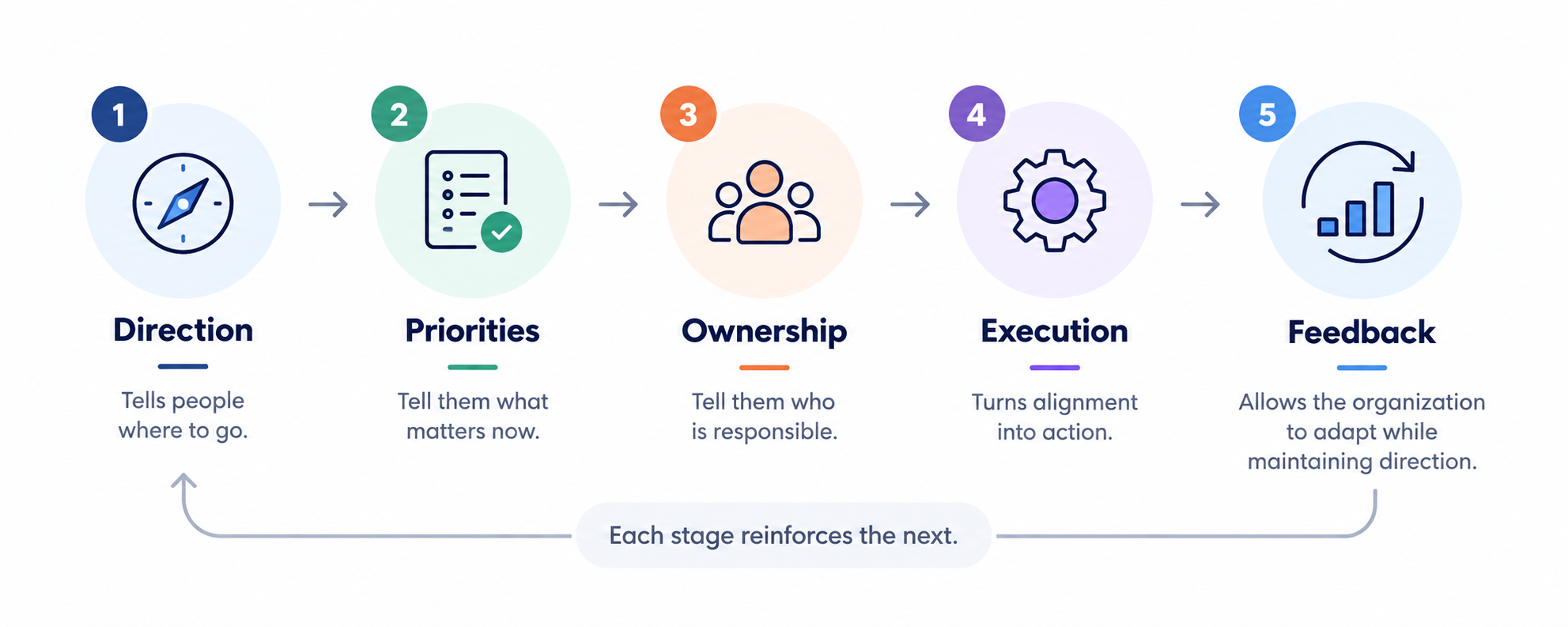
The Alignment Model
A useful way to think about organization-wide alignment is:
Direction → Priorities → Ownership → Execution → Feedback
Each stage reinforces the next:
Direction tells people where to go.
Priorities tell them what matters now.
Ownership tells them who is responsible.
Execution turns alignment into action.
Feedback allows the organization to adapt while maintaining direction.
This creates a system that can move quickly without becoming fragmented.
Alignment Should Increase as Change Accelerates
It may seem logical to give teams more independence when things move quickly.
But rapid change often requires more alignment, not less.
Not more bureaucracy.
More clarity.
When people understand the direction and decision principles, they can act independently without pulling the organization in different directions. That's what allows organizations to move faster without losing control.
LeapView POV: Alignment Is the Infrastructure of Change
At LeapView, we believe organizational change succeeds when people, priorities, and execution move together.
That means:
Creating a clear strategic direction
Translating strategy into actionable priorities
Connecting teams around shared outcomes
Clarifying ownership and decision-making
Creating feedback loops that allow the organization to adapt
Giving people enough context to act with confidence
Because rapid change doesn't have to create organizational chaos.
When teams understand where the organization is going, why it matters, and how their work contributes, change becomes easier to navigate.
Alignment doesn't slow transformation down. It gives transformation momentum.
Is Organizational Misalignment Slowing Your Growth?
Take the LeapView Business Diagnostic to identify gaps across strategy, operations, technology, and organizational execution.
Related Insights