

CX as a Growth Lever, Not a Branding Exercise

For many organizations, Customer Experience (CX) is still viewed as a branding initiative.
It's measured through satisfaction surveys.
Owned by customer-facing teams.
Discussed as part of marketing.
But the organizations leading their industries understand something different.
Customer experience isn't simply about how customers feel about your brand. It's about how your business performs.
When designed intentionally, customer experience becomes a measurable driver of revenue, retention, operational efficiency, and long-term growth.
The question is no longer whether customer experience matters. It's whether your organization is treating it as a business strategy—or just a branding exercise.
Customer Experience Is More Than Perception

Branding shapes expectations. Customer experience fulfills—or fails to fulfill—them.
Customers don't evaluate your company based on one interaction.
They evaluate the entire journey:
Finding your business
Navigating your website
Speaking with sales
Receiving onboarding
Getting support
Renewing or buying again
Every interaction either reinforces trust or creates friction. That cumulative experience directly influences business performance.
Why CX Has Become a Revenue Strategy
Customer experience affects far more than customer satisfaction.
It influences nearly every stage of the revenue lifecycle.
A better experience often leads to:
Higher conversion rates
Greater customer retention
Larger customer lifetime value
More referrals
Lower support costs
In other words, improving customer experience isn't simply improving relationships. It's improving business outcomes.

Why Many Companies Still Get CX Wrong
Despite investing heavily in branding, websites, and customer service, many organizations fail to connect experience with measurable performance.
Why?
1️⃣ CX Is Treated as a Department
Customer experience isn't owned solely by Customer Success.
Marketing influences expectations.
Sales shapes trust.
Operations delivers on promises.
Support reinforces relationships.
Every function contributes to the customer experience.
Treating CX as one department creates fragmented experiences.
2️⃣ Success Is Measured Too Narrowly
Many businesses focus on:
Satisfaction scores
Net Promoter Score (NPS)
Survey responses
These metrics are valuable.
But they don't tell the full story.
Business leaders should also evaluate:
Conversion rates
Customer effort
Retention
Expansion revenue
Churn
Referral rates
Customer experience should be measured by business impact—not just customer sentiment.
3️⃣ Teams Optimize Individual Touchpoints
Organizations often improve:
Landing pages
Sales presentations
Support scripts
But customers don't experience isolated touchpoints.
They experience a continuous journey.
Friction often appears between departments rather than within them.
4️⃣ Operational Problems Become Customer Problems
Delayed approvals.
Poor communication.
Disconnected systems.
Unclear ownership.
Customers may never see these internal issues directly.
But they feel the consequences.
Every operational weakness eventually becomes a customer experience issue.
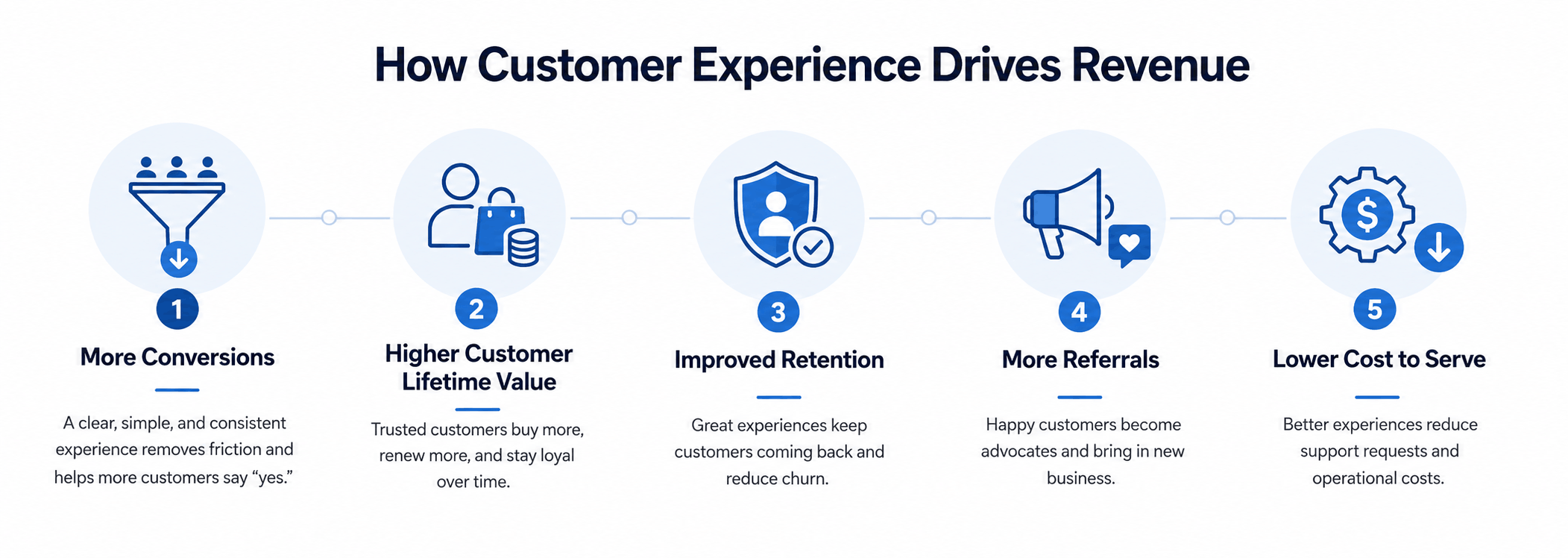
How Customer Experience Drives Revenue
When organizations improve customer experience intentionally, several business outcomes improve simultaneously.
More Conversions
Customers move forward more confidently when experiences are:
Clear
Simple
Consistent
Reducing friction often increases conversion without increasing traffic.
Higher Customer Lifetime Value
Customers who trust an organization are more likely to:
Purchase additional services
Renew agreements
Remain loyal
Experience compounds over time.
Improved Retention
Acquiring customers is expensive.
Keeping them is often far more profitable.
A strong customer experience reduces churn by consistently delivering value throughout the relationship.
More Referrals
Exceptional experiences create advocates.
Happy customers become one of the most effective growth channels an organization can have.
Lower Cost to Serve
Clear communication.
Better onboarding.
Simplified workflows.
These improvements reduce support requests while improving satisfaction.
Operational efficiency and customer experience often improve together.

A Practical Framework for Building CX as a Growth Lever
Step 1: Map the Entire Customer Journey
Understand every interaction from awareness through retention.
Identify:
Customer goals
Friction points
Moments of uncertainty
Opportunities to improve
Visibility creates alignment.
Step 2: Measure Business Outcomes
Go beyond satisfaction metrics.
Track:
Conversion
Retention
Expansion
Customer effort
Support volume
These metrics connect experience directly to growth.
Step 3: Align Every Team Around the Journey
Marketing.
Sales.
Operations.
Customer Success.
Each team should understand how their work influences the customer's overall experience.
Customer experience is cross-functional by nature.
Step 4: Remove Operational Friction
Improve the systems behind the experience.
Examples include:
Faster onboarding
Better internal communication
Clear ownership
Simplified approvals
Connected technology
Great experiences are built through strong operations.
Step 5: Continuously Improve
Customer expectations evolve.
Organizations should continuously review:
Customer feedback
Operational performance
Journey analytics
Team insights
Customer experience should evolve alongside the business.
The Best Customer Experience Is Often Invisible
Customers rarely notice when everything works exactly as expected.
They simply feel:
Confident
Supported
Valued
The smoother the experience, the less customers think about the process, and the more likely they are to continue doing business with you.
That's the goal.
LeapView POV: Customer Experience Is a Business System, Not a Brand Initiative
Customer experience isn't something organizations add after strategy. It should be embedded within it.
At LeapView, we believe customer experience is one of the strongest operational growth levers available to modern businesses.
That means:
Designing customer journeys around business outcomes
Aligning marketing, sales, and operations around one experience
Removing friction that slows customer progress
Measuring CX by its impact on revenue, retention, and operational performance
Because customer experience doesn't simply influence perception. It influences growth.
Organizations that recognize that don't just create happier customers. They build stronger businesses.
Not Sure Where Your Customer Experience Is Costing You Growth?
Take the LeapView Business Diagnostic to uncover the operational and customer journey gaps affecting your business performance.
Related Insights