

The Hidden Cost of Unclear Strategy in Growing Organizations

Growth doesn't always fail because of poor execution.
Sometimes, it fails because the organization is moving quickly—but not in the same direction.
Marketing launches campaigns.
Sales pursues new opportunities.
Operations focuses on efficiency.
Leadership explores expansion.
Everyone is working.
Yet progress feels inconsistent.
Revenue fluctuates.
Priorities shift.
Teams become frustrated.
The issue isn't a lack of effort.
It's a lack of strategic clarity.
As organizations grow, unclear strategy becomes one of the most expensive obstacles to sustainable growth.
What Strategic Clarity Really Means

Strategy isn't simply a business plan.
Nor is it a list of annual objectives.
Strategic clarity means every part of the organization understands:
Who the ideal customer is
What problems the business solves
How it creates differentiated value
Which opportunities deserve attention
How success is measured
Without that shared understanding, teams begin making decisions based on individual assumptions instead of organizational priorities.
The Hidden Cost of Unclear Strategy
Strategic confusion rarely appears overnight.
It accumulates over time. Its impact is often visible long before leadership recognizes the root cause.
1️⃣ Teams Begin Moving in Different Directions
Marketing pursues awareness.
Sales focuses on short-term revenue.
Operations prioritizes efficiency.
Product introduces new capabilities.
Each initiative may seem valuable independently.
Collectively, they create fragmentation.
Instead of building momentum, the organization spreads its resources across competing priorities.
2️⃣ Decision-Making Slows
When priorities are unclear, every decision requires additional discussion.
Questions become increasingly common:
Is this the right opportunity?
Should this project take priority?
Does this support our strategy?
Without a shared framework, leadership spends more time debating than executing.
3️⃣ Customer Messaging Loses Consistency
Strategic ambiguity eventually reaches customers.
Marketing communicates one message.
Sales tells a different story.
Customer Success reinforces something else.
When value propositions shift across touchpoints, trust begins to weaken.
Consistency is a strategic advantage—not just a branding exercise.
4️⃣ Resources Are Spread Too Thin
Growing businesses often chase:
New markets
Additional services
Emerging technologies
New customer segments
Without strategic discipline, organizations attempt everything at once. Focus disappears. Execution suffers.
5️⃣ Growth Becomes Reactive
Rather than pursuing intentional growth, organizations begin reacting to:
Competitor activity
Market trends
Customer requests
Internal pressure
Reactive growth creates complexity faster than capability.

The Difference Between Activity and Strategic Progress
Many organizations appear busy.
Projects increase.
Meetings multiply.
Initiatives expand.
But strategic progress isn't measured by activity.
It's measured by alignment.
The strongest organizations ensure that every major initiative supports a clearly defined strategic objective.
More work doesn't create more growth. Better alignment does.
A Practical Framework for Building Strategic Clarity
Step 1: Define One Clear Growth Direction
Ask:
Who are we building for?
What problems are we uniquely positioned to solve?
Where do we create the greatest value?
Clarity begins with focus.
Step 2: Align Every Function Around Shared Objectives
Marketing.
Sales.
Operations.
Customer Success.
Leadership.
Every team should understand how its work contributes to the same business outcomes.
Step 3: Establish Decision Principles
Not every opportunity deserves attention.
Create criteria that help teams evaluate:
New initiatives
Investments
Partnerships
Product ideas
Decision frameworks reduce organizational friction.
Step 4: Measure Outcomes—Not Activity
Instead of tracking:
Number of campaigns
Number of meetings
Number of projects
Measure:
Revenue growth
Customer acquisition
Retention
Operational efficiency
Customer lifetime value
Outcomes reveal whether strategy is working.
Step 5: Revisit Strategy Regularly—Without Reinventing It
Markets evolve.
Customers change.
Technology advances.
Strategic clarity doesn't require constant reinvention.
It requires disciplined refinement.
Review direction regularly while maintaining consistency in purpose.

Growth Requires More Than a Strategy Document
Many organizations have a strategy. Few have an operating model that supports it.
Execution improves when strategy becomes part of:
Daily decisions
Team priorities
Operational processes
Performance reviews
Strategy should guide the business, not sit inside a presentation.
The Advanced Growth Model: Align Before You Scale
One of the most common mistakes growing organizations make is trying to scale before they align.
They invest in:
More people
More technology
More channels
More initiatives
But scaling misalignment simply creates larger problems.
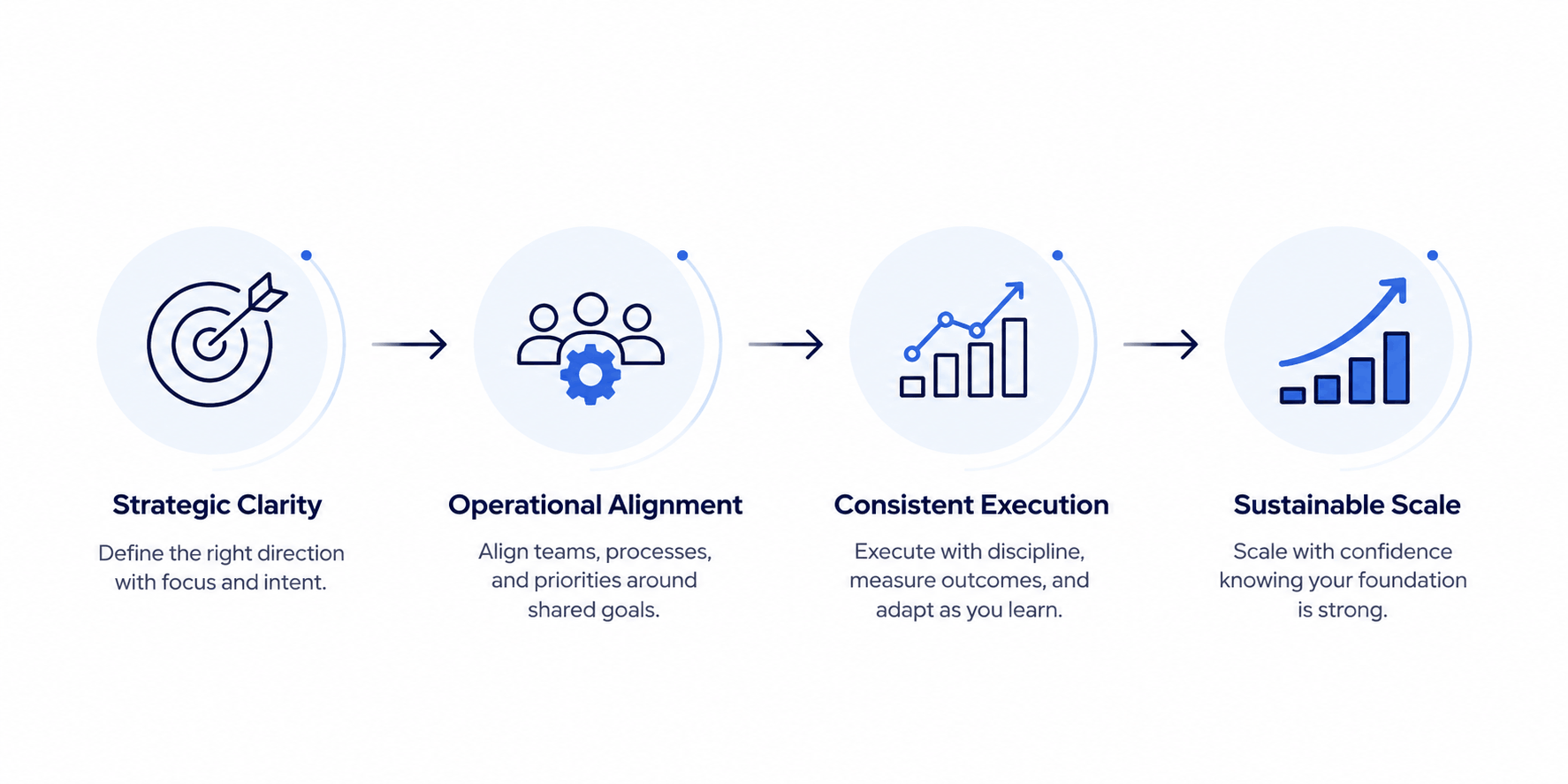
Sustainable growth follows a different sequence:
Strategic Clarity → Operational Alignment → Consistent Execution → Sustainable Scale
Each stage strengthens the next. Growth becomes intentional rather than reactive.
LeapView POV: Growth Accelerates When Strategy Becomes Operational
Many organizations think strategy ends once the planning session is over. At LeapView, we believe that's where strategy begins.
Real growth happens when strategic direction is translated into operational systems that guide decisions across every function.
That means:
Aligning leadership around shared priorities
Connecting Go-To-Market strategy with operational execution
Creating decision frameworks that reduce organizational friction
Building systems that allow growth without sacrificing clarity
Because the greatest cost of unclear strategy isn't slower growth.
It's scaling in the wrong direction.
Organizations that grow sustainably don't simply execute faster. They execute together.
Build a Growth Strategy That Scales With Your Business
Explore how LeapView helps organizations align strategy, operations, and execution to create sustainable growth.
Related Insights