
What Is Agentic AI? And Why It May Be Your Business's Next Competitive Advantage

Artificial Intelligence has already changed how businesses work.
It writes content.
Summarizes documents.
Analyzes data.
Answers questions.
But a new generation of AI is emerging. One that doesn't simply respond to prompts. It takes action.
This is known as Agentic AI.
Unlike traditional AI tools that wait for instructions, Agentic AI can pursue goals, make decisions within defined boundaries, and complete multi-step workflows with minimal human intervention.
For growing businesses, this isn't just another technology trend. It's a new operating model.
Beyond Chatbots: The Evolution of AI
The first wave of AI focused on assistance. You asked a question, the AI generated an answer and the interaction ended there.
Agentic AI changes that dynamic.
Instead of completing one task, AI agents can:
Break complex objectives into smaller tasks
Gather information from multiple sources
Make decisions based on predefined rules
Execute workflows across different systems
Monitor progress and adapt when conditions change
Rather than acting as a tool, Agentic AI behaves more like a digital teammate working toward a defined objective.
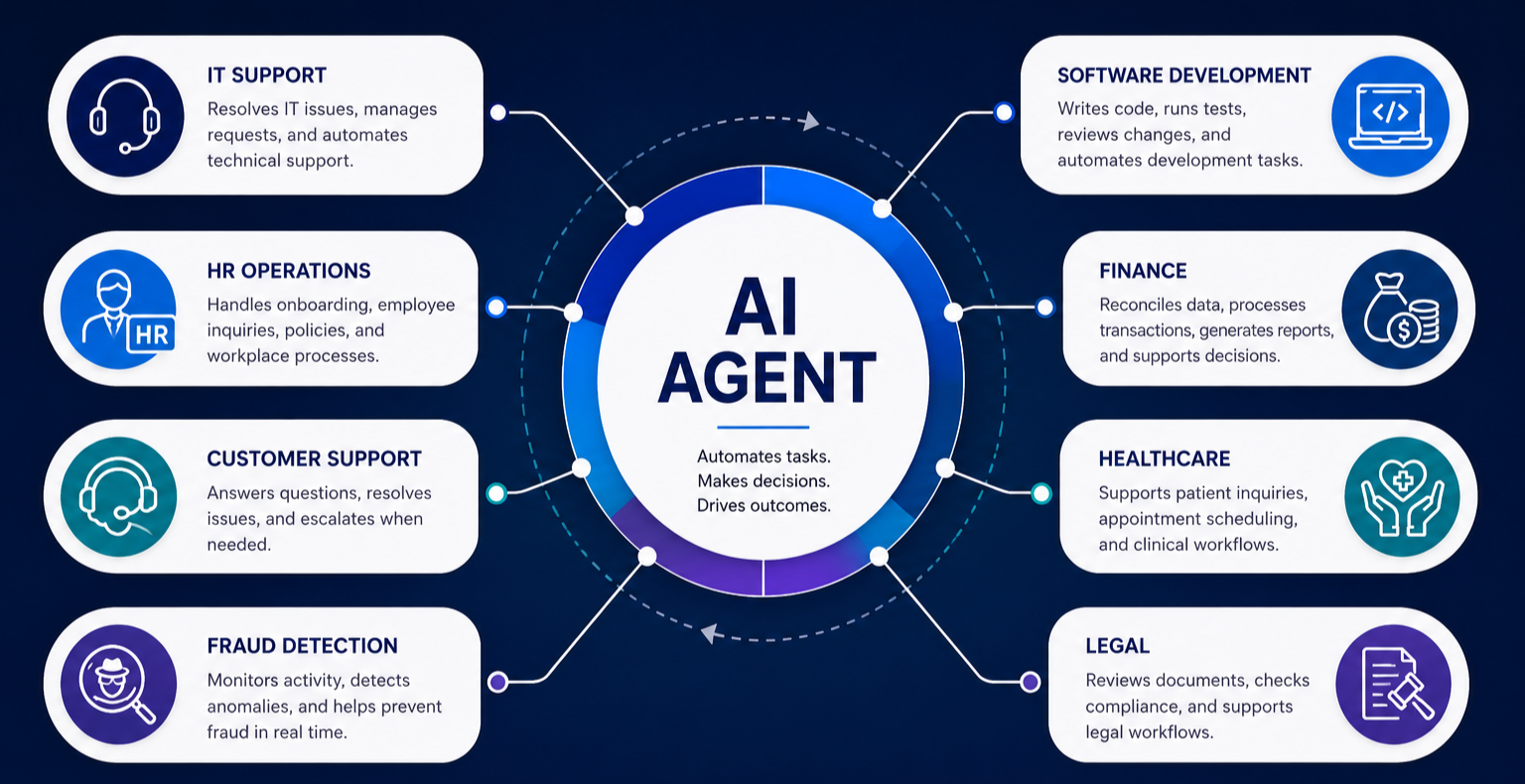
What Makes AI "Agentic"?
An AI system becomes agentic when it can:
Work Toward a Goal
Instead of waiting for each instruction, it understands the desired outcome and determines the sequence of actions needed to achieve it.
Make Operational Decisions
Within predefined limits, it can decide:
Which task to perform first
Which information is relevant
When to escalate to a person
How to respond to changing conditions
Coordinate Multiple Systems
Agentic AI doesn't operate in isolation.
It can interact with:
CRM platforms
Project management tools
Knowledge bases
Customer support systems
Business applications
This allows work to flow across the organization instead of remaining trapped in individual tools.
Learn Through Feedback
Modern AI agents improve over time by analyzing outcomes, identifying inefficiencies, and refining future actions.
Human oversight remains essential, but continuous improvement becomes part of the workflow.

Why Businesses Should Pay Attention
Many organizations already use AI. Few are using it strategically.
Agentic AI shifts the conversation from productivity to operational capability.
Instead of simply helping employees work faster, it enables organizations to redesign how work gets done.
That creates opportunities to:
Reduce repetitive operational work
Improve response times
Increase consistency
Strengthen decision support
Scale without adding unnecessary complexity
Where Agentic AI Creates the Most Value
For many growing organizations, the greatest opportunities are found in operational workflows.
1️⃣ Customer Support
An AI agent can:
Review customer history
Categorize requests
Suggest solutions
Route complex issues to the appropriate specialist
Follow up automatically after resolution
The result is faster service without sacrificing quality.
2️⃣ Sales Operations
AI agents can:
Qualify inbound leads
Update CRM records
Schedule meetings
Generate follow-up communications
Surface opportunities that require human attention
Sales teams spend less time on administration and more time building relationships.
3️⃣ Internal Operations
Routine operational work often consumes valuable time.
Agentic AI can coordinate:
Task assignments
Approval workflows
Reporting
Documentation
Status tracking
This reduces delays while improving visibility across teams.
4️⃣ Executive Decision Support
Leadership teams generate enormous amounts of operational data.
AI agents can:
Monitor KPIs
Identify unusual patterns
Summarize business performance
Highlight operational risks
Recommend areas requiring attention
Leaders receive clearer insights without spending hours compiling reports.
Common Misconceptions About Agentic AI

As with many emerging technologies, misconceptions can slow adoption.
"It Replaces Employees"
Agentic AI is designed to augment human work—not eliminate strategic thinking, creativity, or leadership.
People remain responsible for direction, judgment, and accountability.
"It's Fully Autonomous"
Effective AI agents operate within clear rules.
Organizations define:
Objectives
Permissions
Escalation paths
Governance
Human oversight remains essential.
"Only Large Enterprises Can Use It"
Cloud platforms and modern AI tools have made agentic capabilities increasingly accessible.
Small and mid-sized businesses can often realize significant value by automating targeted workflows rather than attempting large-scale transformation.
Before Implementing Agentic AI, Build the Right Foundation
Technology alone won't create better operations.
Before introducing AI agents, organizations should ensure they have:
Clear Processes
AI performs best when workflows are documented and repeatable.
Undefined processes create inconsistent results.
Reliable Data
AI depends on accurate information.
Poor data quality leads to poor operational decisions.
Defined Governance
Organizations should establish:
Decision boundaries
Security policies
Approval requirements
Performance monitoring
Governance builds trust and reduces risk.
Operational Alignment
Agentic AI should support business strategy—not operate independently from it.
The strongest implementations align technology with customer experience, operational goals, and organizational priorities.
The Future Is Collaborative
The future of work isn't fully automated. It's collaborative.
AI agents will increasingly handle repetitive coordination and operational execution.
People will continue providing:
Strategic direction
Creativity
Judgment
Relationship-building
Leadership
The organizations that succeed won't simply adopt AI. They'll redesign how people and AI work together.
LeapView POV: Agentic AI Is an Operating Model, Not Just a Technology
The conversation around AI often focuses on tools.
At LeapView, we focus on outcomes. We believe Agentic AI represents a new way of designing business operations—where technology actively supports execution instead of simply responding to requests.
That means:
Identifying workflows where AI can create measurable value
Designing operational systems before introducing automation
Establishing governance that balances innovation with accountability
Ensuring people and AI work together to improve performance
Because adopting Agentic AI isn't about replacing how your business operates. It's about building a smarter operating system for sustainable growth.
Build an AI Strategy That Goes Beyond Automation
Explore how LeapView helps organizations identify, design, and implement AI-powered operational systems that improve efficiency, strengthen decision-making, and support scalable growth.
Related Insights