

Preparing Your Operations for AI Before Adopting Tools

AI adoption often starts with a tool.
A new platform.
A new assistant.
An automation.
An AI agent.
But the most important AI decision happens before the technology is selected.
Organizations need to understand whether their operations are actually ready to support it.
Because AI doesn't operate in isolation. It depends on processes, data, systems, people, and decisions that already exist inside the business.
If those foundations are unclear, AI can add complexity instead of removing it.
AI readiness starts with the operation, not the tool.
Why AI Adoption Often Starts in the Wrong Place
The rapid growth of AI has created pressure to adopt quickly.
Organizations are asking:
What AI tools should we buy?
Where can we automate?
Which tasks can AI handle?
Should we build an AI agent?
These are useful questions.
But they come later.
The first question should be:
Where is the business ready for AI to create meaningful value?
That requires understanding how work currently happens.
AI Doesn't Fix Operational Problems by Default
AI can make processes faster.
But faster isn't always better.
Consider a workflow with:
Unclear ownership
Duplicate data
Inconsistent procedures
Poor documentation
Multiple disconnected systems
Adding AI doesn't automatically resolve those issues.
In some cases, it makes them harder to see.
The organization may end up with a sophisticated AI layer sitting on top of an inefficient operating model.
AI amplifies the environment it enters.
That makes operational readiness critical.
What Does AI Readiness Actually Mean?
AI readiness isn't about having the latest technology.
It's about having the organizational conditions required to use AI effectively.
A business is more AI-ready when it has:
Clear processes: People understand how important work gets done.
Accessible data: Relevant information can be found, understood, and used.
Connected systems: Technology doesn't operate entirely in isolated silos.
Defined decision rights: The organization understands where humans make decisions and where technology can assist.
Prepared people: Employees understand how AI will affect their work and how they are expected to use it.
Measurable outcomes: The organization knows what success looks like.
These foundations determine whether AI becomes a useful capability or another layer of complexity.

The Five Dimensions of AI Readiness
A practical readiness assessment can look at five areas.
1. Process Readiness
Before automating a process with AI, understand it.
Ask:
Is the workflow clearly defined?
Are there unnecessary steps?
Are responsibilities clear?
Does the process happen consistently?
Are there frequent exceptions?
If the process is constantly changing or poorly understood, AI may not be the right first step.
Clarity comes before automation.
2. Data Readiness
AI is only as useful as the information it can work with.
Evaluate:
Where data lives
Who owns it
How accurate it is
How current it is
Whether systems can access it
Whether sensitive information is appropriately protected
Organizations often discover that their biggest AI challenge isn't the AI. It's fragmented or unreliable data.
3. Technology Readiness
AI needs to work within the existing technology environment.
Consider:
Current platforms
APIs and integrations
Data flows
Security requirements
Identity and access controls
Legacy systems
The question isn't:
"Can we add AI?"
It's:
"Can AI work effectively within the systems we already depend on?"
4. People Readiness
AI changes how work gets done.
Employees may need to:
Learn new workflows
Review AI-generated outputs
Work alongside AI agents
Develop new skills
Change decision-making habits
Adoption becomes difficult when employees aren't given context or clarity.
People need to understand both what AI can do and where human judgment remains essential.
5. Governance Readiness
AI introduces new questions around:
Privacy
Security
Accuracy
Accountability
Access
Human oversight
Organizations need clear guidelines for how AI is used.
Not every AI capability should have unrestricted access to business information or decision-making authority.
Good governance creates boundaries that allow AI to scale responsibly.
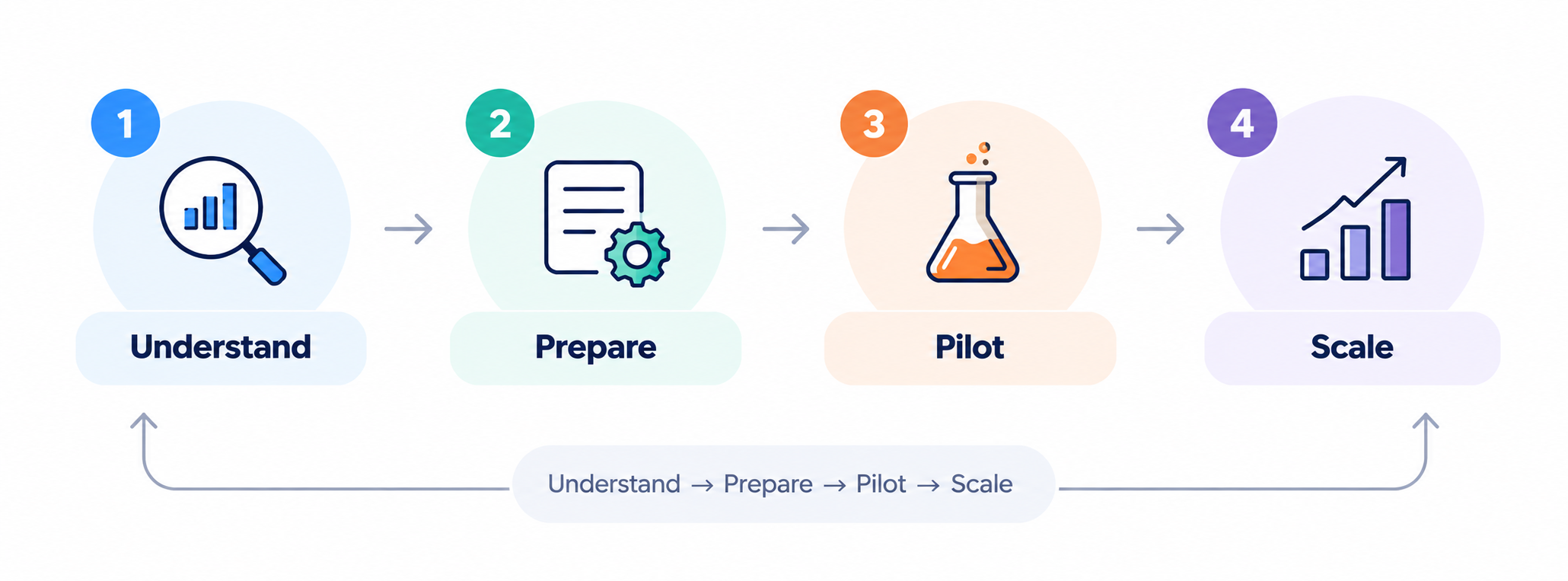
A Practical AI Readiness Framework
Instead of asking whether the organization is simply "ready" or "not ready," evaluate readiness across four levels.
Level 1 — Understand
Know where AI could create value.
Identify processes, decisions, and experiences where AI may have an advantage.
Level 2 — Prepare
Improve processes, data, systems, and ownership.
Remove barriers that would limit AI's effectiveness.
Level 3 — Pilot
Test AI in focused, measurable use cases.
Start small enough to learn without creating unnecessary organizational risk.
Level 4 — Scale
Expand successful applications across the organization.
Build governance, measurement, and operating practices that allow AI to become part of everyday execution.
The sequence matters.
How to Identify the Right AI Opportunities
Not every process should use AI.
Strong candidates often have several characteristics:
High volume
Repetitive work
Large amounts of information
Predictable patterns
Clear inputs and outputs
Significant manual effort
For example:
Summarizing customer interactions
Classifying incoming requests
Generating recurring reports
Identifying patterns in operational data
Supporting employees with information retrieval
The opportunity isn't simply to automate. It's to create measurable improvement.
When AI May Not Be the Right Answer
AI readiness also means knowing when not to use AI.
A process may not be a good candidate when:
The workflow is fundamentally broken
The task happens too rarely
Inputs are unreliable
The consequences of error are extremely high
Human judgment is central to the value
The expected benefit is too small to justify the complexity
Sometimes the best transformation is process simplification.
Sometimes it's traditional automation.
Sometimes it's better training.
And sometimes AI is the right answer.
The objective is to choose the right intervention—not the most fashionable one.
Start With the Problem, Not the AI Tool
A useful sequence for evaluating AI opportunities is:
1. Identify the business problem
What isn't working today?
2. Understand the process
How does the work actually happen?
3. Measure the current state
How much time, cost, effort, or risk does the process create?
4. Define the desired outcome
What should improve?
5. Evaluate technology options
Could AI, automation, or another solution create that improvement?
6. Test and measure
Did the solution actually produce the expected result?
This keeps AI adoption connected to business value.

The Role of Leadership in AI Readiness
AI adoption creates pressure to move quickly.
Leadership needs to balance urgency with discipline.
That means asking:
Where can AI create the greatest value?
What capabilities do we already have?
What operational gaps need to be addressed first?
What risks need to be managed?
How will we measure success?
What should remain human-led?
The goal isn't to slow AI adoption. It's to make sure the organization is prepared to benefit from it.
LeapView POV: Readiness Comes Before Technology
At LeapView, we believe organizations shouldn't start their AI journey by asking which tool to buy.
They should start by understanding whether the business is ready to use AI effectively.
That means:
Assessing operational readiness
Simplifying processes before automating them
Improving data and system foundations
Identifying high-value AI opportunities
Preparing teams for new ways of working
Establishing governance before scaling
Because AI adoption isn't a technology purchase.
It's an operating model transformation.
The organizations that benefit most from AI won't necessarily be the ones that adopt the most tools.
They'll be the ones that build the strongest foundations for using them.
Is Your Business Ready for AI?
Explore how LeapView helps organizations assess operational readiness, identify high-value AI opportunities, and build the foundations for responsible AI adoption.
Related Insights