

Connecting Internal Workflows to Customer Value

Customers don't see most of the work that happens inside a company.
They don't see the approval process behind their request.
They don't see the systems employees have to navigate.
They don't see the handoffs between departments.
They don't see the spreadsheet someone uses to track their account.
But they experience the consequences of all of it.
A delayed response.
A missed handoff.
Conflicting information.
A repetitive request for information they've already provided.
An onboarding process that takes longer than expected.
These aren't simply operational problems.
They're customer experience problems.
The connection between internal workflows and customer value is easy to overlook—but it becomes increasingly important as organizations scale.
Your Customers Experience Your Operations

A customer experience is created by more than customer-facing interactions.
It's also shaped by everything happening behind the scenes.
Consider a simple customer request.:
The customer submits a request.
Someone reviews it.
Another employee approves it.
A different team processes it.
Customer Success follows up.
Finance may need to complete another step.
The customer may only interact with one person. But several internal workflows determine whether that interaction feels:
Fast or slow
Simple or complicated
Consistent or confusing
Personalized or generic
The customer experiences the output of your operating model.
Where Internal Workflows Become Customer Friction
Operational friction becomes a CX issue when it affects the customer's ability to achieve their goal.
Some of the most common examples include:
Slow Handoffs: A request moves between teams without clear ownership.
Duplicate Data Entry: Customers provide the same information multiple times because systems aren't connected.
Unclear Approvals: Internal decisions create unnecessary delays.
Disconnected Information: Different teams have different versions of the customer's information.
Manual Processes: Employees spend time completing repetitive tasks instead of helping customers.
Poor Escalation Paths: Customer issues move slowly because nobody clearly owns the next step.
None of these problems necessarily look like a customer experience strategy issue. But customers feel every one of them.
The Operational-CX Connection
A useful way to understand this relationship is:
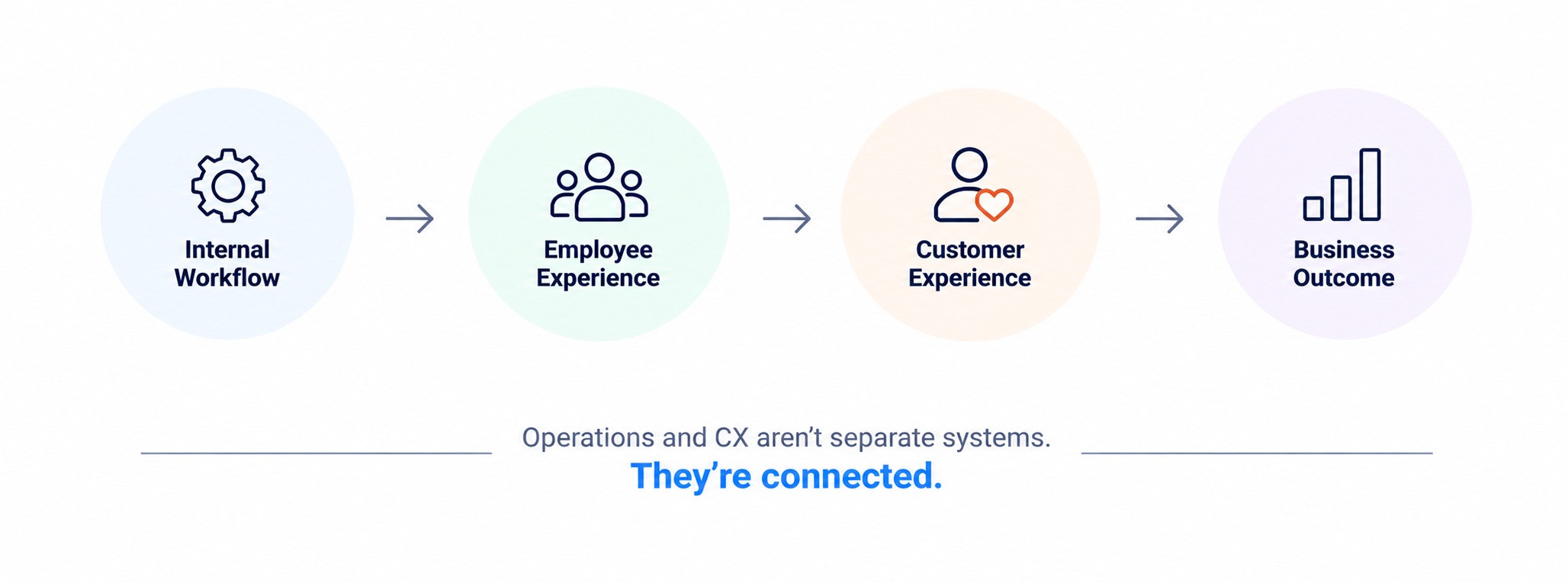
Internal Workflow → Employee Experience → Customer Experience → Business Outcome
When internal workflows are clear and efficient, employees have a better ability to serve customers.
That can lead to:
Faster service → Less customer effort → Higher satisfaction
Better information → More relevant interactions → Greater trust
Clear ownership → Faster resolution → Better retention
Consistent processes → Consistent experiences → Stronger brand perception
Why Optimizing the Customer Journey Isn't Enough
Organizations often map the customer journey from the customer's perspective.
That's important.
But it only shows part of the picture.
Suppose a customer journey reveals that onboarding takes too long.
The solution isn't necessarily a better onboarding email.
The real problem might be:
Sales doesn't collect the required information
Operations has to request it again
Approvals happen manually
Customer Success lacks visibility
Several systems aren't connected
The customer journey identifies where the problem occurs. The internal workflow helps explain why.
That's why CX improvement needs operational visibility.

A Practical Framework for Connecting Workflows to Customer Value
Step 1: Start With the Customer Outcome
Don't begin by asking:
"How can we improve this internal process?"
Start with:
"What is the customer trying to accomplish?"
Examples:
Get started quickly
Resolve an issue
Receive an accurate answer
Complete a purchase
Access a service
Renew a relationship
The desired customer outcome becomes the reference point for operational decisions.
Step 2: Map the Customer Journey
Identify the major stages of the experience.
For example:
Discover → Evaluate → Purchase → Onboard → Use → Support → Renew
Then identify the moments that matter most within each stage.
These are the points where operational performance can have a direct impact on customer value.
Step 3: Map the Internal Work Behind Each Moment
Now look behind the customer journey.
Ask:
Which teams are involved?
What information is required?
Which systems are used?
Where are the handoffs?
Who makes decisions?
Where can delays occur?
This creates a connection between the visible customer journey and the invisible operating system behind it.
Step 4: Identify the Friction
Look for places where internal complexity creates customer consequences.
Ask:
Does this step create value for the customer?
Does it reduce risk?
Is it necessary?
Could it be simplified?
Could technology eliminate the manual effort?
Not every internal process needs to be removed. But every unnecessary point of friction is an opportunity.
Step 5: Prioritize by Customer Impact
Don't try to fix everything.
Prioritize workflows based on:
Customer impact
Frequency
Business value
Operational effort
Risk
Scalability
A small internal improvement that affects thousands of customers may be more valuable than a major redesign of a low-volume process.
Step 6: Redesign the Workflow Around the Outcome
Once friction is identified, redesign the process around what the customer needs.
That may mean:
Removing unnecessary steps
Clarifying ownership
Connecting systems
Automating repetitive activities
Giving employees better information
Creating clearer escalation paths
The objective isn't simply to make internal work faster. It's to make the customer outcome better.

A Simple Example: Customer Onboarding
Consider an organization with a slow onboarding process.
The customer signs the contract.
Then:
Sales sends information to Operations.
Operations requests additional information.
Finance confirms payment.
Another team creates the account.
Customer Success schedules onboarding.
The customer waits.
Each individual step may seem reasonable.
Together, they create friction.
A redesigned workflow might:
Capture information once → Trigger internal tasks automatically → Connect systems → Assign ownership → Give Customer Success visibility → Keep the customer informed
The customer sees a simpler experience.
The organization sees a simpler operation.
That's the connection.
Employee Experience Is Part of Customer Experience
Employees are often the bridge between internal systems and customers.
If employees have to:
Search across multiple systems
Re-enter information
Wait for approvals
Manually compile customer data
Work around broken processes
Customers eventually feel the impact.
Improving employee workflows isn't only an internal productivity initiative.
It can directly improve the quality and consistency of customer interactions.
Better employee experiences can create better customer experiences.
Technology Can Connect the Experience
Technology can reduce the gap between internal operations and customer expectations.
Examples include:
Workflow Automation: Move information and tasks between teams without unnecessary manual intervention.
CRM Integration: Give teams a shared view of customer information.
AI Assistance: Summarize interactions, surface relevant information, or support employees with repetitive work.
Customer Portals: Allow customers to complete tasks without relying on internal teams for every interaction.
Real-Time Visibility: Help employees and customers understand the status of requests, orders, or processes.
But technology should follow the workflow, not define it. Connecting two inefficient processes doesn't make them better.

The Customer Value Chain
A useful model for thinking about internal operations is:
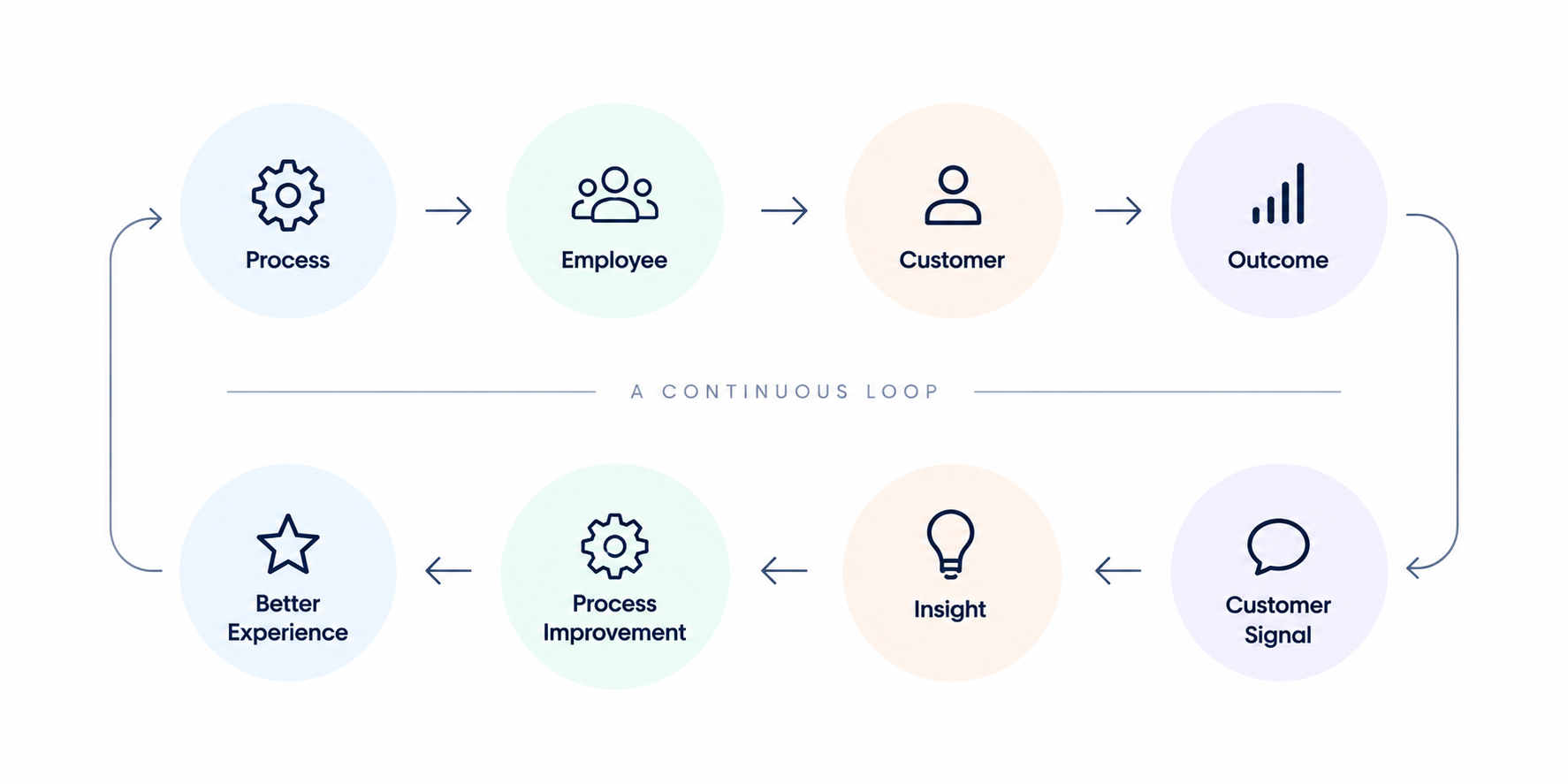
Process → Employee → Customer → Outcome
But the relationship works both ways.
Customer feedback should also inform operational improvement:
Customer Signal → Insight → Process Improvement → Better Experience
This creates a continuous loop.
Operations supports CX.
CX provides information that improves Operations.
The organization becomes better at both.
Don't Automate Customer Friction
Automation can make an inefficient workflow faster.
But it can also make a bad customer experience happen at greater scale.
Before automating a customer-facing workflow, ask:
Is the process necessary?
Is it easy for the customer?
Is the information accurate?
Are exceptions handled appropriately?
Is human intervention needed?
Only after those questions are answered should automation enter the conversation.
The objective isn't to automate the customer experience. It's to improve it.
LeapView POV: Customer Experience Is Built Inside the Business
At LeapView, we believe customer experience doesn't begin at the customer-facing interface. It begins inside the organization.
The processes, systems, people, and decisions behind every interaction determine the experience customers ultimately receive.
That means:
Connecting internal workflows to customer outcomes
Mapping operational friction behind the customer journey
Aligning teams around shared customer goals
Simplifying processes before introducing technology
Using automation and AI where they improve customer and business outcomes
Measuring operational performance through its impact on customer value
Because customers don't experience your org chart.
They experience how well the organization works.
When internal operations are designed around customer value, better experiences become a natural outcome of better execution.
Where Is Operational Friction Affecting Your Customers?
Take the LeapView Business Diagnostic to uncover gaps across your customer journey, operations, technology, and execution.
Related Insights