

Customer Base Management (CBM): A Practical Framework for Growth

Most growth strategies begin with the same question:
How do we acquire more customers?
But as a business matures, another question becomes just as important:
How do we create more value from the customers we already have?
Acquisition will always matter.
But sustainable growth isn't built on acquisition alone.
Your existing customer base represents revenue you've already earned, relationships you've already established, and opportunities you've already created.
The challenge is knowing how to manage that base intentionally.
That's where Customer Base Management (CBM) comes in.
CBM provides a structured way to understand, segment, retain, grow, and activate an organization's existing customers—turning the customer base into an active growth engine rather than simply a list of accounts.
What Is a GTM Stack?

Customer Base Management is the systematic approach to managing existing customers based on their value, needs, behavior, potential, and stage in the relationship.
Instead of treating every customer the same, CBM asks:
Who are our most valuable customers?
Which customers are at risk?
Where is expansion possible?
Which customers could become advocates?
What does each segment need from us?
The goal isn't simply to retain customers. It's to maximize the long-term value of the customer base.
Why Customer Acquisition Isn't the Whole Growth Story
Acquisition is visible. New customers create obvious activity:
New leads
New opportunities
New contracts
New revenue
Existing-customer growth is often less visible. But customers can create additional value through:
Renewals
Upsells
Cross-sells
Expansion into new locations or teams
Referrals
Advocacy
A business that continuously acquires customers without strengthening its existing base can end up working harder just to maintain growth.

The Problem With Treating Every Customer the Same
Not every customer has the same:
Revenue potential
Retention risk
Product adoption
Strategic value
Growth opportunity
Yet many companies use the same communication, service model, and engagement strategy across their entire customer base. That's inefficient.
A high-value strategic account may need a completely different approach from a low-engagement customer with limited expansion potential.
Segmentation creates focus.
The Four Growth Opportunities Within Your Customer Base
A practical CBM model looks at four interconnected opportunities.
1. Retain
Protect the value you've already created.
Focus on:
Customer satisfaction
Product or service adoption
Relationship health
Renewal readiness
Early warning signals
Retention is the foundation.
2. Expand
Identify opportunities to increase the value of existing relationships.
This might include:
Additional services
More users
Higher-tier offerings
New business units
Additional locations
Expansion becomes easier when the organization understands customer needs rather than simply pushing additional products.
3. Develop
Some customers have potential that hasn't yet been realized.
They may need:
Better onboarding
Greater adoption
Education
Strategic support
New use cases
Customer development focuses on helping customers reach more value—which can create more value for the business as well.
4. Activate
Satisfied customers can become growth assets.
They may:
Refer new customers
Provide testimonials
Participate in case studies
Recommend the business
Become advocates within their networks
The customer relationship can extend beyond revenue.
A Practical CBM Framework

Customer Base Management becomes useful when it moves from theory into an operating process.
Here's a simple framework organizations can use.
Step 1: Understand Your Customer Base
Start by building visibility.
Analyze customers by factors such as:
Revenue
Profitability
Tenure
Product usage
Engagement
Growth potential
Retention risk
The objective is to understand the composition of your customer base—not just its total size.
Step 2: Segment Customers by Opportunity
Create meaningful customer segments.
For example:
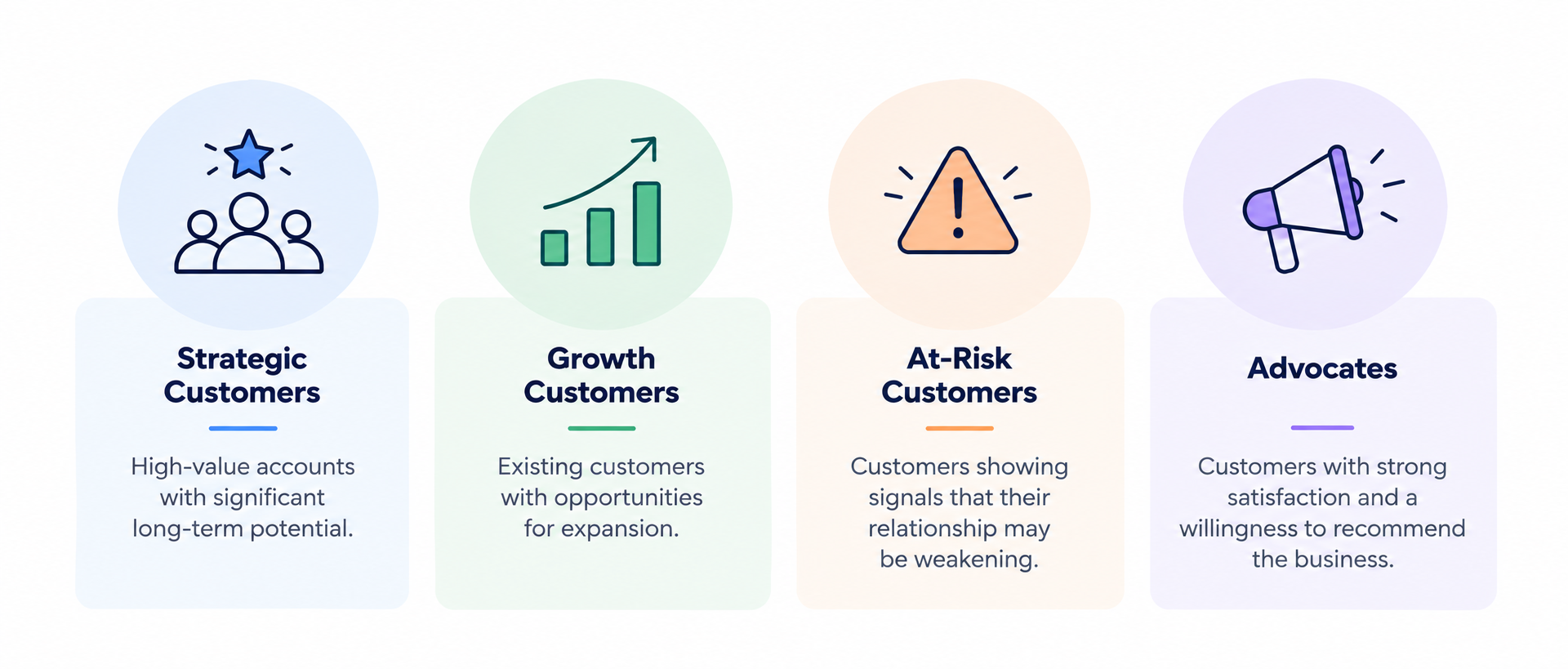
The exact segments will vary by organization. What matters is creating segments that lead to different actions.
Step 3: Define the Strategy for Each Segment
Once customers are segmented, determine what each group needs.
For example:
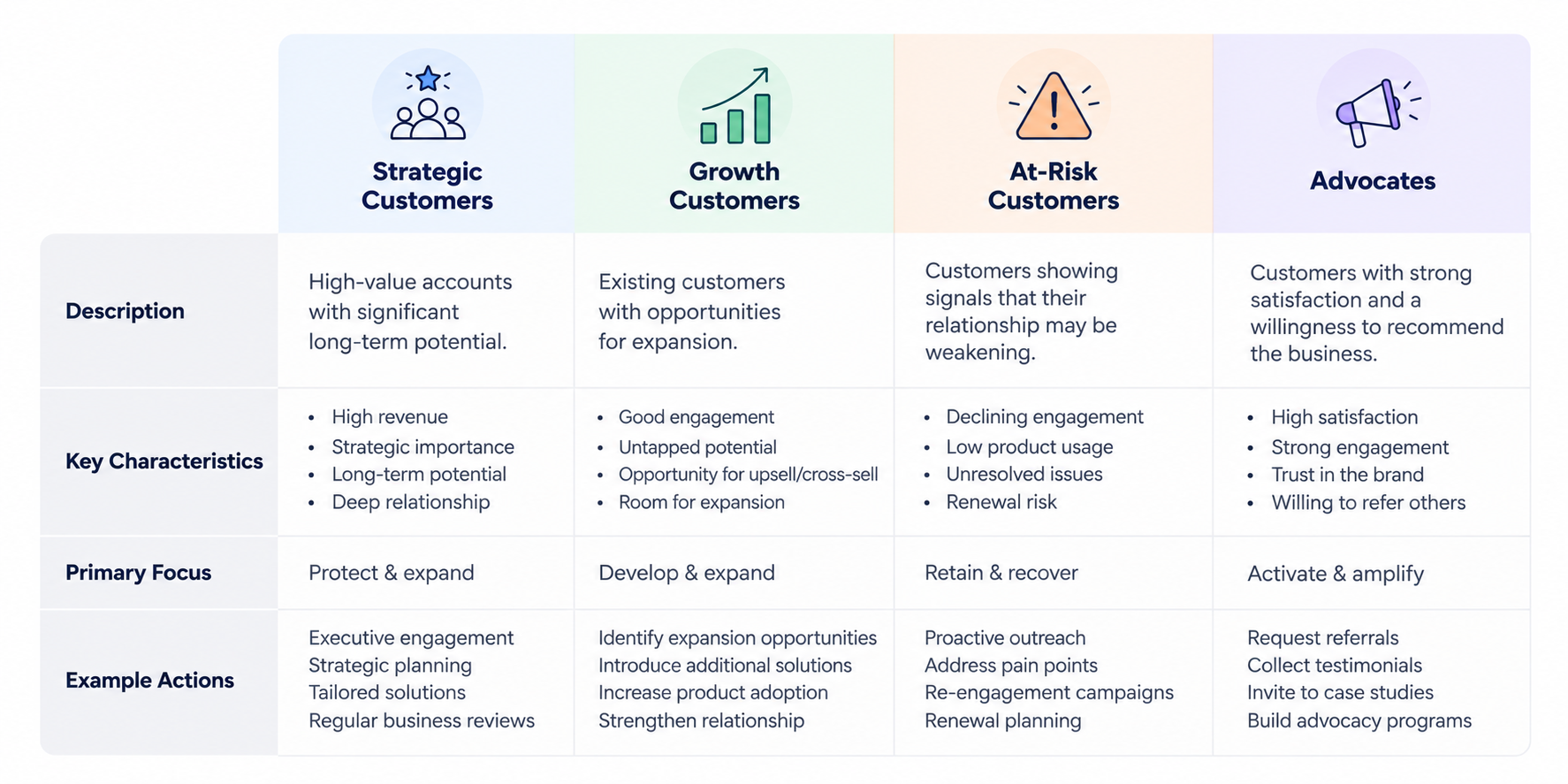
This turns customer data into a growth strategy.
Step 4: Connect Sales, Marketing, and Customer Success
CBM cannot live inside one department.
Marketing may identify engagement opportunities.
Sales may identify expansion potential.
Customer Success may identify adoption issues.
Operations may identify service friction.
When these teams operate independently, opportunities remain hidden. When they share customer intelligence, the organization can act earlier and more strategically.
Step 5: Build a Customer Health Model
Customer health shouldn't depend entirely on intuition.
Develop signals that help identify:
Engagement
Adoption
Satisfaction
Support activity
Renewal risk
Expansion potential
The goal isn't to create a complicated scoring system. It's to give teams enough visibility to know where attention is needed.
Step 6: Create Actions, Not Just Reports
A customer dashboard isn't a CBM strategy. Every meaningful signal should lead to an action.
For example:
Low adoption → customer education
Declining engagement → proactive outreach
Strong adoption → expansion conversation
High satisfaction → advocacy opportunity
The value comes from connecting insight to execution.
The Role of Technology in Customer Base Management
Technology can make CBM significantly more effective.
CRM platforms, customer success tools, analytics, and AI can help organizations:
Consolidate customer information
Identify patterns
Track account health
Automate alerts
Surface expansion opportunities
Personalize engagement
But technology isn't the strategy. A sophisticated CRM cannot compensate for unclear customer segmentation or disconnected teams.
The operating model comes first. Technology should make that model easier to execute.
Where AI Can Strengthen CBM
AI creates new possibilities for customer base management.
It can help organizations identify patterns that would otherwise be difficult to see across large customer populations.
For example, AI can help:
Detect changes in customer behavior
Identify potential churn signals
Summarize account activity
Prioritize accounts for attention
Surface potential expansion opportunities
Personalize customer communications
This moves CBM from a largely reactive process toward a more proactive one.
But AI should support judgment—not replace the customer relationship.
The Metrics That Matter
A strong CBM strategy should connect customer activity to business outcomes.
Useful metrics include:
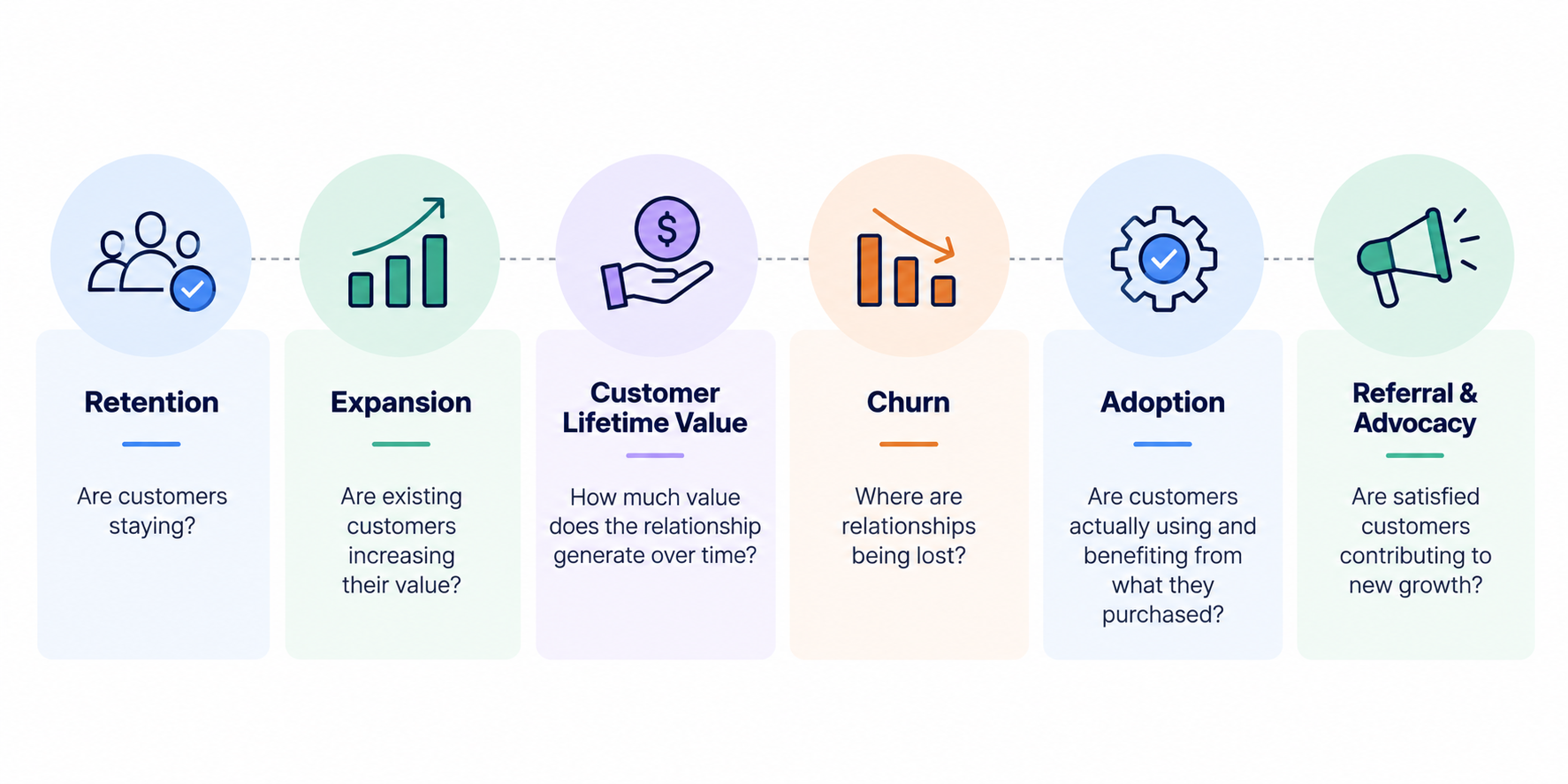
The right metrics depend on the business model, but the principle remains the same: Measure the health and economic value of the customer base, not just its size.
The Advanced Growth Model
Traditional GTM models often emphasize acquisition:
Attract → Convert → Close
CBM extends the growth model beyond the initial transaction.
A more mature growth system looks like:
Acquire → Develop → Retain → Expand → Advocate
Each stage creates opportunities for the next.
A customer isn't simply the endpoint of the sales process. They can become the starting point for the next cycle of growth.
Why This Matters as Companies Scale
As a company grows, its customer base becomes more complex.
There are more:
Accounts
Relationships
Products
Renewal dates
Opportunities
Customer needs
Without a structured approach, valuable opportunities become difficult to identify.
CBM creates a system for managing that complexity.
Instead of asking:
"How do we get more customers?"
Leadership can begin asking:
"How do we create more value across the customers we already serve?"
That's a more mature growth question.
LeapView POV: Your Customer Base Is a Growth System
At LeapView, we believe sustainable growth requires looking beyond acquisition.
Your existing customers are not simply accounts to maintain.
They are a source of:
Revenue
Expansion
Insights
Referrals
Long-term relationships
Customer Base Management creates the structure to turn those opportunities into an intentional growth engine.
That means:
Segmenting customers based on value and opportunity
Connecting customer intelligence across teams
Identifying retention and expansion signals
Using technology and AI to increase visibility
Turning customer insights into consistent action
Because sustainable growth isn't only about finding the next customer. It's about creating more value from every relationship you already have.
Turn Your Customer Base Into a Growth Engine
Explore how LeapView helps organizations align Go-To-Market strategy, customer experience, and operations to unlock sustainable growth from the customers they already serve.
Related Insights