

When Vision Is Clear but Execution Isn’t: What’s Missing

Most leaders don't struggle because they lack a vision.
They know where they want the business to go.
They may have a clear growth strategy, defined objectives, and a strong understanding of the market.
And yet, months later, progress feels slower than expected.
Projects stall.
Priorities compete.
Teams wait for decisions.
Initiatives lose momentum.
The strategy makes sense on paper.
Execution is where it breaks down.
When vision is clear but execution isn't, the problem is usually not the strategy itself.
Something between knowing what to do and consistently doing it is missing.
The Strategy–Execution Gap

A strategy defines direction.
Execution turns that direction into results.
The gap appears when an organization can answer:
"Where are we going?"
but struggles to answer:
"How do we consistently get there?"
This often happens because strategy documents focus on outcomes while leaving the operating mechanisms undefined.
A leadership team may say:
Grow revenue
Improve customer retention
Expand into new markets
Improve operational efficiency
Adopt AI
But these goals don't automatically tell teams:
What happens first
Who owns each initiative
Which decisions need to be made
What resources are required
How progress will be measured
What should stop
Execution requires more than direction. It requires a system.
What Execution Actually Requires
Strong execution depends on several connected elements.
Think of it as:
Clarity → Priorities → Ownership → Capability → Measurement → Feedback
If one of these is missing, execution becomes harder.
1️⃣ Clear Priorities
A strategy can contain many objectives.
Execution cannot treat everything as equally important.
When every initiative is labeled a priority, teams have no real prioritization.
This creates:
Context switching
Resource conflicts
Delayed decisions
Incomplete projects
A strong execution model identifies what matters now.
The question isn't:
"What could we work on?"
It's:
"What must move forward for the strategy to succeed?"
2️⃣ Clear Ownership
One of the most common execution gaps is ambiguous ownership.
A project may have several people involved but no one clearly accountable for the outcome.
Participation isn't ownership.
Execution requires someone who can answer:
What needs to happen?
By when?
What is blocking progress?
What decisions are needed?
What happens next?
Clear ownership reduces the amount of work that gets stuck between teams.
3️⃣ Decision-Making Mechanisms
Organizations can have capable people and still move slowly.
Why?
Because decisions aren't structured.
Teams may not know:
Who has decision authority
When leadership needs to be involved
What information is required
How quickly decisions should be made
When every decision escalates upward, leadership becomes the bottleneck.
Good execution gives teams enough authority to move while establishing clear escalation points for higher-risk decisions.
4️⃣ The Right Capabilities
Sometimes the strategy is sound but the organization doesn't yet have the capabilities required to execute it.
For example, a company may want to:
Scale sales
Expand internationally
Introduce AI
Improve customer experience
But its current systems, skills, processes, or leadership capacity may not support those ambitions.
The question becomes:
What capabilities must exist for this strategy to become executable?
That might mean developing:
New skills
Better technology
Stronger processes
Additional capacity
New roles
Cross-functional capabilities
Strategy should be tested against organizational reality.
5️⃣ Measurement that Drives Action
Execution requires visibility.
But measuring everything doesn't necessarily improve execution.
The most useful metrics help teams understand:
Are we moving toward the outcome we want?
For example, instead of only measuring the number of initiatives completed, leadership might track:
Revenue impact
Customer retention
Time to market
Adoption
Operational capacity
Conversion
Productivity
Metrics should help teams decide what to continue, change, or stop.
6️⃣ A Feedback Loop
Execution doesn't happen in a perfectly predictable environment.
Customers change.
Markets shift.
Resources change.
Assumptions prove wrong.
A strong execution system creates regular opportunities to learn and adjust.
That means asking:
What is working?
What isn't?
What did we learn?
What has changed?
What should we do differently?
Feedback isn't a sign that the strategy failed. It's how strategy stays connected to reality.

The Warning Signs of an Execution Gap
Execution problems often reveal themselves through recognizable patterns.:
Too Many Initiatives: The organization keeps starting new projects without completing existing ones.
Constant Reprioritization: Teams repeatedly change direction because priorities aren't sufficiently defined.
Leadership Becomes the Bottleneck: Important decisions continually return to senior leaders.
Meetings Increase but Progress Doesn't: Teams spend more time coordinating work than moving it forward.
Accountability Is Unclear: Everyone is involved, but no one clearly owns the result.
Teams Optimize in Isolation: Departments hit their individual goals while the organization struggles to achieve its broader objectives.
Strategy Changes Before Execution Has Time to Work: Leadership introduces a new direction before the previous one has been properly executed or evaluated.
These aren't necessarily signs of bad leadership. They are often symptoms of an operating system that hasn't caught up with the organization's ambitions.
A Practical Execution Diagnostic
When execution isn't working, don't immediately rewrite the strategy.
First, diagnose where the breakdown occurs. Ask these six questions:
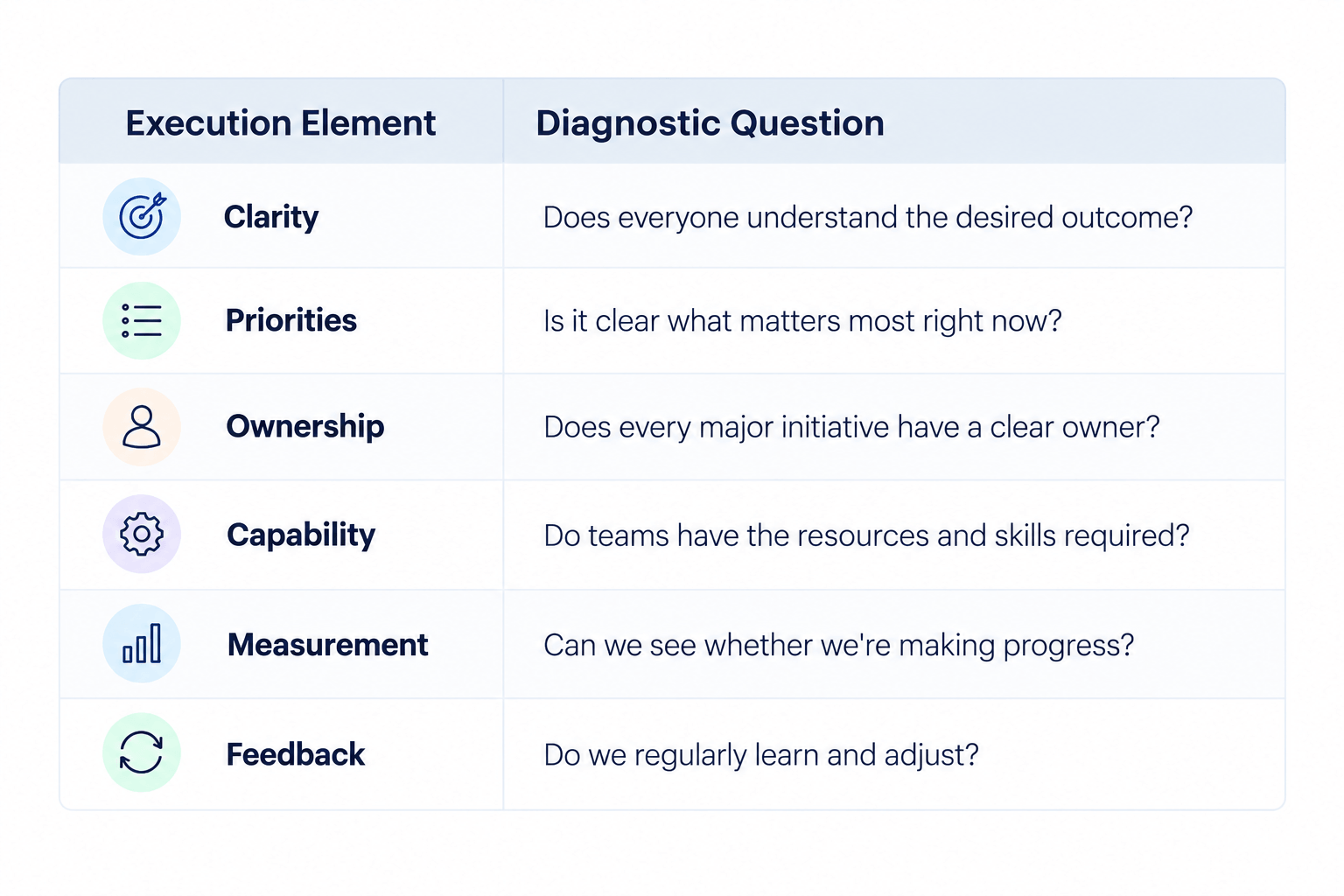
If the answer to several of these is unclear, the problem may not be the strategy.
The execution system is incomplete.

From Strategy to Execution
A useful way to think about the relationship is:
Vision → Strategy → Priorities → Execution → Outcomes
Each stage translates the previous one into something more actionable.
Vision: Where do we want to go?
Strategy: How will we create advantage?
Priorities: What matters most now?
Execution: What will we actually do?
Outcomes: What changed as a result?
The further an organization moves down this chain, the more specific its decisions need to become.
Vision can be broad. Execution cannot.
When the Answer Is to Simplify
Sometimes the missing ingredient isn't another system.
It's less complexity.
If teams are struggling to execute, consider whether the organization has:
Too many priorities
Too many approval layers
Too many tools
Too many competing metrics
Too many initiatives
Too many handoffs
Simplification can create more execution capacity than adding another management layer.
Execution often improves when organizations remove what gets in the way.
Build an Operating System Around the Strategy
A strategy becomes executable when the organization builds the structures around it.
That can include:
Clear goals
Defined priorities
Ownership models
Decision rights
Operating rhythms
Performance measures
Cross-functional workflows
Feedback mechanisms
These mechanisms translate strategic intent into repeatable behavior.
That's what turns strategy from a document into an operating system.
LeapView POV: Strategy Only Creates Value When It Can Be Executed
At LeapView, we believe the distance between strategy and execution is where many organizations lose momentum.
A clear vision is important.
But vision alone doesn't create results.
Organizations need the systems, processes, people, and decision mechanisms required to turn strategic intent into consistent action.
That means:
Translating strategy into actionable priorities
Creating clear ownership
Removing execution friction
Connecting teams around shared outcomes
Building capabilities that support the strategy
Measuring progress through meaningful business outcomes
Creating feedback loops that allow the organization to adapt
Because the question isn't simply whether your organization knows where it wants to go.
It's whether the organization is designed to get there.
Is Your Strategy Clear but Execution Still Stalling?
Take the LeapView Business Diagnostic to identify the strategic, operational, and organizational gaps that may be limiting execution.
Related Insights